
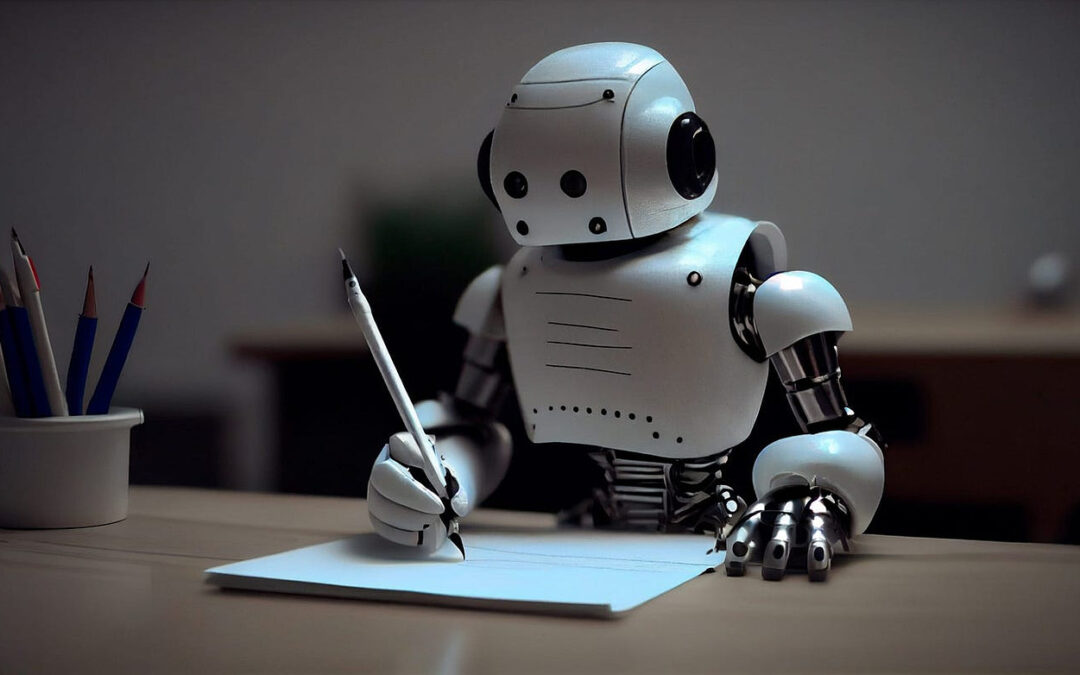
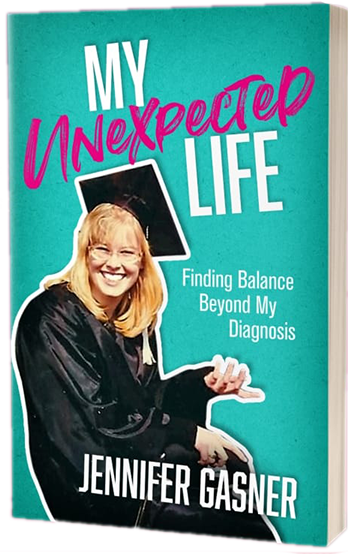
I didn’t use AI when I wrote My Unexpected Life.
Using AI would have been an easier route than typing, which is a slow and often frustrating experience. Because of Friedreich’s ataxia (FA), fine motor skills are not my thing. So handwriting is out of the question too.
Just over a decade ago when I started compiling my stories, AI was still in its infancy. It wasn’t an option. I even tried making recordings that somebody else transcribed. I’m sure it was a boring and tedious task for my friend. So I began typing. There were days when the writing process felt like running a marathon through deep mud with my fingers. My mind would be flooded with details I wanted to capture, but my hands took much longer to execute the vision. The biggest benefit of this time-consuming process was that the act of physically typing helped me process what I was going through emotionally as I put my thoughts and memories onto the page.
The only assistive technology at my disposal at the time was voice-to-text. But I found that frustrating because my voice doesn’t always convert correctly. My choppy cadence and slurred speech make it a more complicated process than it is for people without speech issues. Also, the bridge between my brain and voice didn’t perform as well as the bridge between my brain and fingers. Only through typing did my creative spark come alive.
As a disabled author, I often navigate a world of lower expectations. There is a constant, quiet bias about disability that assumes I can’t write with coherence, deep emotion, or even a varied vocabulary. I wish this weren’t true. As I wrote in my epilogue, “I hope the craft speaks for itself.” I want people to know I have generated a beautiful book through hard work, talent, and perseverance.
Looking Forward: AI as Assistive Technology
In the past, I thought using AI was cheating. But as I write my next book, my perspective on voice-to-text and AI is evolving.
Typing has become more cumbersome as I age and my FA progresses, and I find myself relying on voice-to-text more often, even with its errors. Somehow, now, that bridge between my voice and my creativity is getting me where I want to go. It’s becoming easier to articulate myself without physically typing.
Plus, the technology has drastically improved since I tried Dragon NaturallySpeaking, an early voice recognition program I used in grad school before the millennium (a marker of my age!). It didn’t work for me at all—and my speech was clearer than it is today! Now, Google Voice Typing and the dictate function on my Mac can understand me pretty well in comparison.
I am cultivating the shift in my creativity and emotional process much like I had to transition from handwriting to using a computer (another Gen X tell!). It’s awkward right now, but my hope is that I am still expressing myself in a way that stays true to the voice I established in my first book.
Have you heard about spoon theory? It’s the idea that we have a limited amount of energy (spoons) each day. For a non-disabled writer, formatting a manuscript or making some updates might take a few spoons. For me, that same mechanical and sometimes tedious work can drain my entire day’s supply, leaving nothing left for the actual creative writing.
I’m starting to see AI as a tool to help me maintain my spoons. I use it with very clear boundaries. I’m not interested in using AI word for word. To me, the value of AI lies in its ability to complete tasks much faster than I could, not in the actual storytelling.
This blog post evolved using AI. I had an initial idea for a blog post, and I created some copy. Then, AI organized it and helped me identify what I needed to emphasize or expand on. It also helped me focus on my message. I asked it to correct any grammatical or spelling errors. Then, my human editor gave me suggestions about how to improve it more and make the voice sound more like mine.
I also use AI to generate alt text for images on social media posts and my website, and to create text for marketing purposes. It helps me conserve spoons.
When AI helps me with the fundamental hurdles, it isn’t cheating. It’s equalizing. It functions like a digital wheelchair or a ramp; it doesn’t tell me where to go, but it helps me get there without being exhausted before I even arrive. It puts me on equal footing with all the faster-typing writers out there.
There is a sense of guilt regarding the environmental impact of AI. Because of that, I don’t use it for trivial things—like creating pictures of my dog as Yoda. I only use it as a tool for my writing and marketing. It gets my creative juices flowing, organizes my thoughts, and conserves energy.
Keeping the “Work” in the Work
My plan for the next project is to use AI to generate ideas and move through the process faster. But I will go back in and replace the output using my own voice and words. It will be my own work. As AI evolves, maybe it will give me more support, and I will be open to adapting with it.
I want to spend less energy on the practical aspects of the story so I can spend more energy on the heart of it. My first book proves I can do it the traditional way. The next book will be about doing it a new way—keeping up with the technology available to me, and remaining proud because using tools doesn’t make me a cheater or a bad writer. It makes me better. And that’s the kind of improvement I hope AI brings to us all.
Recent Comments